Όλα στο Γκάζι, στην Τεχνόπολη του δήμου Αθηναίων...
30.9.11
Στο Μουσείο Κυκλαδικής Τέχης, 3/10, 19.00 -20.30
Ο Helmut Middendorf στη Βαρβάκειο Αγορά στην Αθήνα.
Φωτογραφία: Jochen Littkeman
Ο Χέλμουτ Μίντεντορφ γεννήθηκε το 1953 στο Ντινκλάγκε της Γερμανίας. Από τις αρχές της δεκαετίας του '90 η ζωή του είναι μεταξύ Αθήνας και Βερολίνου. Ανήκει στις ιστορικές μορφές της νεότερης γερμανικής τέχνης και οι πίνακές του εντάσσονται στον νέο-εξπρεσιονισμό, που με αφετηρία την Γερμανία του '70, έγιναν γνωστοί ως ‘νέο-φώβ’, ή αλλιώς ‘νέο-άγριο’.
Από το ξεκίνημα της πορείας του τη δεκαετία του '70, ο καλλιτέχνης ως ενεργό μέλος του γερμανικού εικαστικού κινήματος των ‘νεο-αγρίων’, βρίσκεται σε μια διαρκή προσπάθεια ανατροπής των στερεοτύπων και αναζήτησης νέων τρόπων έκφρασης, συχνά με μία γερή δόση χιούμορ και πάντα με ποικίλες αναφορές στην Ιστορία της Τέχνης.
Έργα του έχουν παρουσιασθεί σε πολλές ατομικές και ομαδικές εκθέσεις και περιλαμβάνονται σε σημαντικές συλλογές τέχνης ανά τον κόσμο. Τα έργα του Δαφνί και A2, που συμπεριλαμβάνονται στην έκθεση ‘The Last Grand Tour. Σύγχρονοι Περιηγητές στην Ελλάδα’, προέρχονται από μια σειρά που ο καλλιτέχνης δημιούργησε εξετάζοντας το αστικό τοπίο της Αθήνας. Στα έργα αυτά, σκηνοθετεί ζωγραφικά κολάζ από τσιμεντένιες κατασκευές που αντανακλούν τους γκρίζους τόνους της απεικόνισης της πόλης της Αθήνας.
Η συν-ομιλία του Middendorf με τον Ντέννη Ζαχαρόπουλο εντάσσεται στο πρόγραμμα ‘Τι να κάνουμε;’ στο πλαίσιο του οποίου το Μουσείο προσκαλεί καλλιτέχνες, θεωρητικούς και διανοούμενους να παρουσιάσουν την δουλειά τους ή/και τις απόψεις τους γύρω από τα ελληνικά και διεθνή θέματα αιχμής, σε συμφωνία με το τρέχον εικαστικό πρόγραμμα σύγχρονης τέχνης του Μουσείου. Στο πλαίσιο του προγράμματος έχουν πραγματοποιηθεί οι ομιλίες των:
Doug Aitken (07.06.2011) και Lynda Benglis (21.09.2011).
Το πρόγραμμα επιμελείται η ιστορικός τέχνης, Μαρίνα Βρανοπούλου.
INFO
Η ομιλία θα διεξαχθεί στα αγγλικά. Είσοδος ελεύθερη
Θα ακολουθήσει συζήτηση με το κοινό.
Δευτέρα 3 Οκτωβρίου 2011, 19.00 – 20.30
Μουσείο Κυκλαδικής Τέχνης
Νεοφύτου Δούκα 4, Αθήνα
28.9.11
Μια «ψαριά» καλή...
Στην Ελλάδα των επιχειρημάτων όμως υπάρχουν και οι άνθρωποι των πράξεων. Διόλου τυχαία, καθώς δεν είναι όλοι της συνομοταξίας Ηλία Κικίλια, της συζύγου του Αναστασίας και της κουνιάδας του Βασιλικής Χάραρη του Ιωάννη: όπου κ. Κικίλιας, βλέπε Διοικητής ΟΑΕΔ, όπου Αναστασία Χάραρη βλέπε υπάλληλος ΟΑΕΔ, στο μόνιμο προσωπικό ΠΕ, για να μην την ανησυχεί η εφεδρεία, όπως όταν ήταν στο Παρατηρητήριο Απασχόλησης και…τέλος, όπου Βασιλική Χάραρη βλέπε γραμματέας του γαμπρού της. Ω, τι κόσμος μπαμπά. Εδώ στην Ελλάδα, η δημόσια δαπάνη ξεπερνά ακόμη και την πιο άγρια βλάστηση.
Ένας από τους άλλους, λοιπόν, τους αποφασιστικούς σε καιρούς κρίσης είναι ο Ιεροκλής Μιχαηλίδης, ο οποίος οδηγήθηκε στην απόφαση, η « Ανωτέρα Δραματική Σχολή Β. Διαμαντόπουλος» να υλοποιήσει με ίδιους πόρους αυτοτελή κύκλο σπουδών δωρεάν κατάρτισης ανέργων στις δραματουργικές σπουδές.
Δηλώνει ο άνθρωπος-και διευθυντής σπουδών της σχολής-: «Στην απόφασή μας αυτή μας οδήγησε η κωλυσιεργία και η αδυναμία της ελληνικής γραφειοκρατίας να απορροφήσει τα χρήματα που προβλέπονται από τα κοινοτικά προγράμματα και καλύπτουν το 95% του κόστους των σπουδών και της επιδότησης.
Σ’ αυτή την παράλογη και απολύτως ακατανόητη αδράνεια, απαντάμε με την δωρεάν κατάρτιση 120 άνεργων νέων από 18 έως 29 ετών στη Θεσσαλονίκη.
Στην προσπάθεια μας να πραγματοποιηθούν τα κοινοτικά προγράμματα και να μην επιστρέψουν τα χρήματα στα κοινοτικά ταμεία, απευθύνουμε εξώδικη δήλωση, πρόσκληση, διαμαρτυρία προς την Ειδική Υπηρεσία ΕΠΕ «Ανάπτυξη Ανθρώπινου Δυναμικού» της Γενικής Γραμματείας Διαχείρισης Κοινοτικών και άλλων Πόρων του Υπουργείου Εργασίας και δεσμευόμαστε ότι η σχολή μας, με τη 18ετή πείρα άμεμπτης διαχείρισης ανάλογων Ευρωπαϊκών Προγραμμάτων, ότι στις 5 Οκτωβρίου του 2011 θα πραγματοποιήσει εξετάσεις, για την επιλογή των 120 άνεργων της Θεσσαλονίκης και της Β. Ελλάδος, στους οποίους θα δοθεί η δυνατότητα να σπουδάσουν δωρεάν την υποκριτική, από κορυφαίους θεωρητικούς και πρακτικούς της σκηνικής τέχνης στην Ελλάδα.
Στις 5 Οκτωβρίου ταυτόχρονα με τις εξετάσεις θα εξηγήσουμε δημόσια σε συνέντευξη τύπου τους λόγους της διαμαρτυρίας και των πρωτοβουλιών μας».
ΑΝΩΤΕΡΑ ΔΡΑΜΑΤΙΚΗ ΣΧΟΛΗ
ΒΑΣΙΛΗΣ ΔΙΑΜΑΝΤΟΠΟΥΛΟΣ
ΜΗ ΚΕΡΔΟΣΚΟΠΙΚΟΥ ΧΑΡΑΚΤΗΡΑ
ΕΓΝΑΤΙΑΣ 45 Τ.Κ.54630- ΘΕΣ/ΚΗ
ΤΗΛ.: 2310530660 FAX: 2310530661
Εγκεκριμένη από το Υπουργείο Πολιτισμού με
την υπ’ αριθμό 22922/177/31.7.2007 απόφασή του
Θέλει και ερώτημα, αν το χαράτσι πηγαίνει παρακάτω; Σαφώς και όχι. Για να αποδειχτεί η παταγώδης αποτυχία, δε χρειάζεται δεινή ρητορική σαν του Tony Blair, ο οποίος φέρεται να έχει λάβει συνολικά περίπου 400.000 λίρες για δύο ομιλίες του μισάωρου σε μια 36ωρη παραμονή του στις Φιλιππίνες για το 2009- σύμφωνα με δημοσίευμα της 26ης Μαΐου 2010, από την εφημερίδα The Independent -. Απλά τα πράγματα: γιατί εθελοτυφλούν και φορούν πολύ τελευταία–σε γραβάτες και πουκάμισα- το λιλά; Είναι όντως το χρώμα της θεραπείας αλλά αλίμονο αν αγαπήσουμε την ασθένεια και την μιλάμε ως αν ήταν η δεύτερη φύση μας.
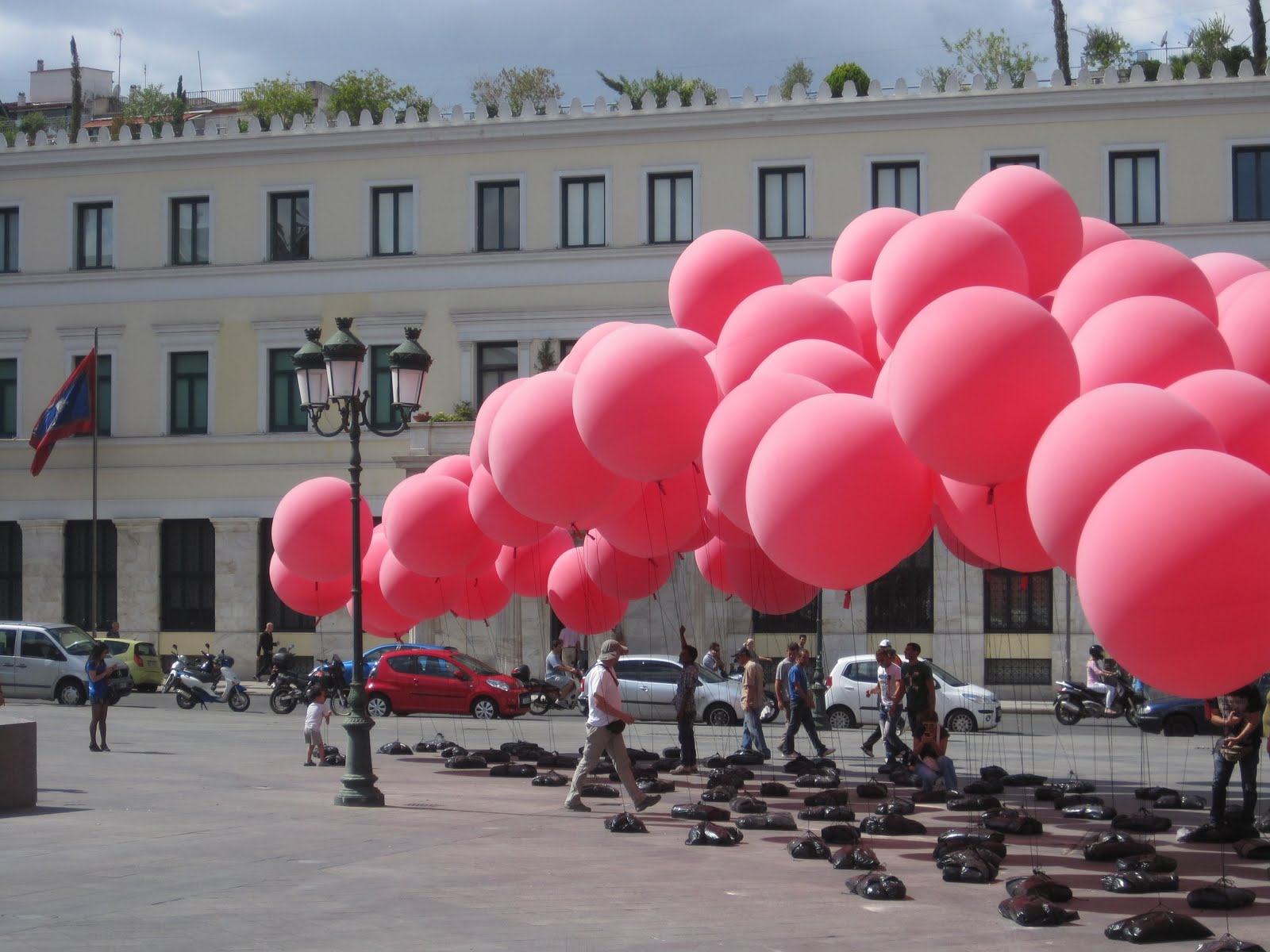
Στενάχωρες ειδήσεις είναι άλλες: είναι η λεηλασία στο πατρικό του Νικηφόρου Βρεττάκου στην Πλούμιτσα Λακωνίας, είναι στην πλατεία Κοτζιά, μπροστά από το Δημαρχιακό Μέγαρο η αφαίρεση των μπαλονιών από τη μεγάλη εγκατάσταση Red Eyed Sky Walkers της Τζένης Μαρκέτου. Το σημαντικό έργο, που ανήκει στη συλλογή του Εθνικού Μουσείου Σύγχρονης Τέχνης, έμεινε στην ιστορία ως το έργο που ήταν. Το συναποτελούσαν 99 μετεωρολογικά κόκκινα μπαλόνια και μικρές ασύρματες βίντεο κάμερες τοποθετημένες ανάμεσά τους, ενώ πρόβαλλαν σε πραγματικό χρόνο τις εικόνες στο εσωτερικό ενός γειτονικού καφενείου. Όχι πια. Επειδή «δεν υπάρχει ένας πολιτικός», θα έλεγε κάποιος. Το ίδιο θα μπορούσε να έχει πει και η διευθύντρια του Ε.Μ.Σ.Τ, Άννα Καφέτση, την περασμένη Πέμπτη 22 Σεπτεμβρίου, κατεβαίνοντας τη Σταδίου το μεσημέρι. Σαν αυτή η χώρα να μην έχει καλλιτεχνική συνείδηση αλλά και σαν κάποιοι να δρουν χωρίς έμπνευση, χωρίς διαίσθηση.
23.9.11
Το κάλεσμα της ειρήνης προς όλους για την Τράπεζα Χρόνου και ένα άλλο νέο «παιδείας».
https://docs.google.com/spreadsheet/formResponse?hl=en_US&formkey=dDVBTXlmZTZNY2xUazlSOS05MWM0UFE6MQ&theme=0AX42CRMsmRFbUy1mNGY3MzQyYi02MzhlLTQ5OTEtOTdiMS1jZjNmNGNiY2I0NGU&ptok=1910293358805281228&ifq
Μπορείτε να ανταποκριθείτε στο κάλεσμα της Ειρήνης που μου έστειλε το email.
Διότι, διευκρινίζεται, από την ίδια, πως δεν είναι απαραίτητο να είστε μέλη κάποιας ομάδας ή δικτύου που κάνει ανταλλαγές, για να λάβετε μέρος.
Οι απαντήσεις του ερωτηματολογίου, στο πλαίσιο της έρευνας για την Τράπεζα Χρόνου, η οποία διεξάγεται από το Πανεπιστήμιο Κρήτης, θα χρησιμοποιηθούν στη διατριβή και σε δημοσιεύσεις σε συνέδρια και περιοδικά. Εννοείται ότι όλες οι απαντήσεις είναι ανώνυμες και μάλιστα το ηλεκτρονικό ερωτηματολόγιο επιτρέπει να μην ξέρει ούτε η ερευνήτρια- Ειρήνη Σωτηροπούλου- ποιος έχει απαντήσει τι.
Καθώς έχω υπάρξει υπότροφος του ΙΚΥ και γνωρίζω από καθυστερήσεις, συμμερίζομαι την αγωνία της Ειρήνης, που σημειώνει στο ίδιο email, ότι: η έρευνα έχει εγκριθεί για υποτροφία από το πρόγραμμα Ηράκλειτος ΙΙ, αλλά ακόμη δεν έχει υπογράψει σύμβαση, δεν έχει λάβει καμία χρηματοδότηση μέχρι στιγμής και επίσης, αρνούνται να της καταβάλουν τα αναδρομικά της από το 2009 που εργάζεται για την έρευνα αυτή.
Βεβαίως, η αναφορά σε αυτά τα «παρασκηνιακά» της έρευνας, περί χρηματοδότησης δικαιολογείται για λόγους δεοντολογίας της έρευνας. Με τη συμμετοχή μας δεν συνεισφέρουμε μόνο στη δύναμη της ανωνυμίας αλλά και στην πραγματοποίηση της έρευνας για κάθε ερευνητή, πανεπιστήμιο και φορέα που συνεχίζει το έργο. Για να μη μας κλέβουν τη νεότητα: την προσοχή, τον ενθουσιασμό, το στόχο.
Από την άλλη πλευρά, τώρα, έρχεται η άλλη είδηση, «αφαίμαξης προσοχής» ότι:
220.000 ευρώ θα στοιχίσουν τα DVD που θα δοθούν αντί σχολικών βιβλίων!
Δημοσιεύθηκε: 12/9/2011, 12:00 - Εμφανίσεις: 179
- Στην εταιρία του συζύγου της υπουργού η ανάθεση αναπαραγωγής
Με 220.000 ευρώ επιχορηγείται το Ινστιτούτο Τεχνολογίας Υπολογιστών και Εκδόσεων (ΙΤΥΕ) «Διόφαντος» που εδρεύει στην Πάτρα για την παραγωγή των DVD που θα δοθούν στα Γυμνάσια και τα Λύκεια, για την... αναπλήρωση των σχολικών βιβλίων που, λόγω πρωτοφανών καθυστερήσεων από τον ΟΕΔΒ, δεν έχουν ακόμη τυπωθεί!
Τη σχετική απόφαση υπέγραψε την περασμένη Δευτέρα η υπουργός Παιδείας Άννα Διαμαντοπούλου, στην οποία αναφέρεται ότι τα DVD θα έχουν «το περιεχόμενο των διδακτικών βιβλίων του Γυμνασίου - Λυκείου σε ψηφιακή μορφή και τη διανομή τους σε όλα τα Γυμνάσια - Λύκεια της χώρας έως την έναρξη του σχολικού έτους 2011 2012, με την πλέον πρόσφορη διαδικασία»!
Η αναπαραγωγή των DVD των βιβλίων που θα μοιραστούν στα σχολεία θα γίνει από εταιρία του συζύγου της Υπουργού Παιδείας με το απαραίτητο υπερκέρδος.
"Ο Πρόεδρος της Γ' ΕΛΜΕ Αθήνας κ. Κόκλας κατήγγειλε σήμερα ότι η αναπαραγωγή των DVD που θα μοιραστούν στα σχολεία θα γίνει από εταιρία του συζύγου της Αννούλας και θα στοιχίσουν 5 ευρώ το ένα (τιμή αγοράς ενός κενού στην αγορά 0,75ε). Το συνολικό κόστος παρεμπιπτόντως για το υπουργείο θα είναι 220.000 ευρώ".
Πηγή: www.tanea-london.net
*(Φωτογραφία) they never gave up:αυτό είναι το μήνυμα και έρχεται από την Fedra Santos και την Πορτογαλία. Η φωτογραφία δείχνει μέρος του έργου της, Old Folk του 2007, που εκτέθηκε στη 14η Μπιενάλε νέων καλλιτεχνών Ευρώπης και Μεσογείου, των Σκοπίων, το 2009. Στην ίδια Μπιενάλε, εκπροσωπούσα την Ελλάδα στην ποίηση.
220.000 ευρώ θα στοιχίσουν τα DVD που θα δοθούν αντί σχολικών βιβλίων!
Δημοσιεύθηκε: 12/9/2011, 12:00 - Εμφανίσεις: 179
- Στην εταιρία του συζύγου της υπουργού η ανάθεση αναπαραγωγής
Με 220.000 ευρώ επιχορηγείται το Ινστιτούτο Τεχνολογίας Υπολογιστών και Εκδόσεων (ΙΤΥΕ) «Διόφαντος» που εδρεύει στην Πάτρα για την παραγωγή των DVD που θα δοθούν στα Γυμνάσια και τα Λύκεια, για την... αναπλήρωση των σχολικών βιβλίων που, λόγω πρωτοφανών καθυστερήσεων από τον ΟΕΔΒ, δεν έχουν ακόμη τυπωθεί!
Τη σχετική απόφαση υπέγραψε την περασμένη Δευτέρα η υπουργός Παιδείας Άννα Διαμαντοπούλου, στην οποία αναφέρεται ότι τα DVD θα έχουν «το περιεχόμενο των διδακτικών βιβλίων του Γυμνασίου - Λυκείου σε ψηφιακή μορφή και τη διανομή τους σε όλα τα Γυμνάσια - Λύκεια της χώρας έως την έναρξη του σχολικού έτους 2011 2012, με την πλέον πρόσφορη διαδικασία»!
Η αναπαραγωγή των DVD των βιβλίων που θα μοιραστούν στα σχολεία θα γίνει από εταιρία του συζύγου της Υπουργού Παιδείας με το απαραίτητο υπερκέρδος.
"Ο Πρόεδρος της Γ' ΕΛΜΕ Αθήνας κ. Κόκλας κατήγγειλε σήμερα ότι η αναπαραγωγή των DVD που θα μοιραστούν στα σχολεία θα γίνει από εταιρία του συζύγου της Αννούλας και θα στοιχίσουν 5 ευρώ το ένα (τιμή αγοράς ενός κενού στην αγορά 0,75ε). Το συνολικό κόστος παρεμπιπτόντως για το υπουργείο θα είναι 220.000 ευρώ".
Πηγή: www.tanea-london.net
*(Φωτογραφία) they never gave up:αυτό είναι το μήνυμα και έρχεται από την Fedra Santos και την Πορτογαλία. Η φωτογραφία δείχνει μέρος του έργου της, Old Folk του 2007, που εκτέθηκε στη 14η Μπιενάλε νέων καλλιτεχνών Ευρώπης και Μεσογείου, των Σκοπίων, το 2009. Στην ίδια Μπιενάλε, εκπροσωπούσα την Ελλάδα στην ποίηση.
21.9.11
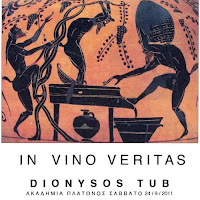
IN VINO VERITAS: 24/9, 6.00 μμ.στην Ακαδημίας Πλάτωνος
στην Ακαδημία Πλάτωνος
Στο πλαίσιο της συνεργασίας του Εθνικού Μουσείου Σύγχρονης Τέχνης με το Υπουργείο Πολιτισμού και Τουρισμού και τον Δήμο Αθηναίων για τις εκδηλώσεις στην Αθήνα, το Σάββατο 24 Σεπτεμβρίου θα δημιουργηθεί στο αρχαιολογικό άλσος της Ακαδημίας Πλάτωνος ένα νέο έργο, με τίτλο
IN VINO VERITAS που θα περιλαμβάνει μια εγκατάσταση και μια σειρά δράσεων, με ώρα έναρξης τις 6.00 μμ.
Η εγκατάσταση/δράση διαχειρίζεται τις καταβολές της εκφοράς του δημόσιου ποιητικού λόγου στο διονυσιακό θέατρο και δημιουργήθηκε ως ανταπόκριση στην σημερινή κατάσταση της πόλης της Αθήνας και σε συσχετισμό με την εποχή του φθινοπώρου και τον τρύγο.
Η δράση στοχεύει στην ανάδειξη της ενεργούς σχέσης ανάμεσα στην συνάθροιση, την εκφώνηση, την συν-διατροφή, τον χορό και το σώμα.
Στη συγκεκριμένη περιοχή της Ακαδημίας Πλάτωνος, τα συνδηλούμενα είναι η σχέση της πολυπολιτισμικότητας, του ξένου (κάτοικοι της περιοχής) με τον Διόνυσο, θεότητας που αφορά το «ξένο» μέσα στον κάθε πολίτη, την μέθη, αυτό που ως «άγριο» ή «μη πολιτισμένο» καταλαμβάνει τον άνθρωπο στον διονυσιασμό. Ταυτόχρονα, η δομή της δράσης αναφέρεται από τη μία με το πάτημα σταφυλιών στον συλλογικό και ανώνυμο χορό και από την άλλη με την ποιητική απαγγελία στο εξατομικευμένο πρόσωπο, τα δύο συστατικά στοιχεία της δομής του αρχαίου δράματος.
Μαζί με τα παραπάνω, σε αναφορά με την αρχαία θέση της Ακαδημίας, γίνεται ένα σχόλιο στον Πλάτωνα και το θέμα της πλατωνικής «ιδέας», με την τελική μορφή που παίρνει η εγκατάσταση, καθώς διαμορφώνεται ως ένα είδος ίχνους/μνημείου/αναπαράστασης της ίδιας της δράσης μετά το πέρας της.
Συγκεκριμένα η εγκατάσταση και η δράση περιγράφονται ως εξής:
1. ΕΓΚΑΤΑΣΤΑΣΗ/ ΘΕΑΤΡΟ
Στο αρχαιολογικό πάρκο της Ακαδημίας Πλάτωνος θα εγκατασταθεί ένα «θέατρο-πατητήρι».
Επί του δαπέδου της πλατείας θα τοποθετηθεί ένα κεντρικό πατητήρι (ορχήστρα). Μπροστά του θα τοποθετηθούν περίπου ενενήντα δεμάτια σταριού σε παράλληλες σειρές. Τα δεμάτια θα χρησιμοποιούνται ως πρόχειρες θέσεις για τους θεατές του πατήματος του σταφυλιού (κοίλον). Τέλος, οι ομιλητές (υποκριτές) της δράσης θα στέκουν σε ιδεατό «βήμα», μπροστά σε υπάρχοντες διάσπαρτους αρχαίους δομικούς λίθους (σκηνή).
Η προτεινόμενη διάταξη του χώρου έχει απευθείας αναφορά στην αρχική διάταξη του ελληνικού θεάτρου, με την σκηνή-λογείον, την ορχήστρα και το κοίλον. Η διονυσιακή διάσταση του ανοικτού θεάτρου τονίζεται από την σχέση ανάμεσα στον χορό και το πάτημα των σταφυλιών.
IN VINO VERITAS που θα περιλαμβάνει μια εγκατάσταση και μια σειρά δράσεων, με ώρα έναρξης τις 6.00 μμ.
Η εγκατάσταση/δράση διαχειρίζεται τις καταβολές της εκφοράς του δημόσιου ποιητικού λόγου στο διονυσιακό θέατρο και δημιουργήθηκε ως ανταπόκριση στην σημερινή κατάσταση της πόλης της Αθήνας και σε συσχετισμό με την εποχή του φθινοπώρου και τον τρύγο.
Η δράση στοχεύει στην ανάδειξη της ενεργούς σχέσης ανάμεσα στην συνάθροιση, την εκφώνηση, την συν-διατροφή, τον χορό και το σώμα.
Στη συγκεκριμένη περιοχή της Ακαδημίας Πλάτωνος, τα συνδηλούμενα είναι η σχέση της πολυπολιτισμικότητας, του ξένου (κάτοικοι της περιοχής) με τον Διόνυσο, θεότητας που αφορά το «ξένο» μέσα στον κάθε πολίτη, την μέθη, αυτό που ως «άγριο» ή «μη πολιτισμένο» καταλαμβάνει τον άνθρωπο στον διονυσιασμό. Ταυτόχρονα, η δομή της δράσης αναφέρεται από τη μία με το πάτημα σταφυλιών στον συλλογικό και ανώνυμο χορό και από την άλλη με την ποιητική απαγγελία στο εξατομικευμένο πρόσωπο, τα δύο συστατικά στοιχεία της δομής του αρχαίου δράματος.
Μαζί με τα παραπάνω, σε αναφορά με την αρχαία θέση της Ακαδημίας, γίνεται ένα σχόλιο στον Πλάτωνα και το θέμα της πλατωνικής «ιδέας», με την τελική μορφή που παίρνει η εγκατάσταση, καθώς διαμορφώνεται ως ένα είδος ίχνους/μνημείου/αναπαράστασης της ίδιας της δράσης μετά το πέρας της.
Συγκεκριμένα η εγκατάσταση και η δράση περιγράφονται ως εξής:
1. ΕΓΚΑΤΑΣΤΑΣΗ/ ΘΕΑΤΡΟ
Στο αρχαιολογικό πάρκο της Ακαδημίας Πλάτωνος θα εγκατασταθεί ένα «θέατρο-πατητήρι».
Επί του δαπέδου της πλατείας θα τοποθετηθεί ένα κεντρικό πατητήρι (ορχήστρα). Μπροστά του θα τοποθετηθούν περίπου ενενήντα δεμάτια σταριού σε παράλληλες σειρές. Τα δεμάτια θα χρησιμοποιούνται ως πρόχειρες θέσεις για τους θεατές του πατήματος του σταφυλιού (κοίλον). Τέλος, οι ομιλητές (υποκριτές) της δράσης θα στέκουν σε ιδεατό «βήμα», μπροστά σε υπάρχοντες διάσπαρτους αρχαίους δομικούς λίθους (σκηνή).
Η προτεινόμενη διάταξη του χώρου έχει απευθείας αναφορά στην αρχική διάταξη του ελληνικού θεάτρου, με την σκηνή-λογείον, την ορχήστρα και το κοίλον. Η διονυσιακή διάσταση του ανοικτού θεάτρου τονίζεται από την σχέση ανάμεσα στον χορό και το πάτημα των σταφυλιών.
2. ΔΡΑΣΕΙΣ
Μετά την εγκατάσταση του «θεάτρου», θα ξεκινήσει η δράση του «πατήματος του σταφυλιού», το απόγευμα του Σαββάτου από τις 6 μμ.
Η δράση/δράμα χωρίζεται σε τρεις φάσεις:
α. Το πάτημα των σταφυλιών με συνοδεία κρουστού.
Στο ρυθμικό πάτημα σταφυλιών συμμετέχουν οι συντελεστές του συμβάντος καθώς και παρευρισκόμενοι.
β. Την παρασκευή μουσταλευριάς και την εκφορά λόγου.
Κατά την διάρκεια της παρασκευής της μουσταλευριάς θα γίνει οργανωμένη δράση εκφοράς λόγου διάρκειας 20-25ʼ γύρω από την θεματική του οίνου και την μέθη, με κολλάζ ποιητικών και άλλων κειμένων. Στην δράση χρησιμοποιούνται κείμενα από διαφορετικές πηγές, όπως: Όμηρο, Οσίπ Μάντελσταμ, Δημοτικά τραγούδια, Διοσκουρίδη, Ανακρεόντεια, Μαρίνα Τσβετάγεβα, Καρλ Μαρξ, Φρήντριχ Χέλντερλιν, Μισέλ Σερ, Φρήντριχ Νίτσε, Αρχίλοχο, Αντόνιο Νέγκρι, Συνταγές, Πιερ-Πάολο Παζολίνι, Μαγικούς Παπύρους, Έμιλυ Ντίκινσον.
γ. Τη διανομή μουσταλευριάς στους παρευρισκομένους.
3. ΜΝΗΜΕΙΟ
Μετά το τέλος της δράσης, από τα χρησιμοποιημένα δεμάτια του «κοίλου» θα δημιουργηθεί (ως αναφορά στον Πλάτωνα) υπό μορφή διάτρητου πύργου το μνημείο της, ένα είδος «ίχνους» της δράσης. Από τον πύργο θα εκπέμπεται ως ηχητική εγκατάσταση η τεκμηρίωση από επανασυντεθειμένα ηχητικά θραύσματα των δράσεων της 24/9. Το μνημείο θα διατηρηθεί στη θέση του κατά την διάρκεια της έκθεσης.
Διάρκεια: 25/09-02/10
Ώρες λειτουργίας: 10.00- 19.00
Δράση Απαγγελίας: Δραματουργία και Εκφορά Κειμένων: Ισαβέλλα Μαρτζοπούλου, Στέργιος Μπαρρές
Συμμετέχουν οι ποιητές και εικαστικοί καλλιτέχνες: Αντώνης Βολανάκης, Φοίβη Γιαννίση, Γιάννης Γρηγοριάδης,Ορέστης Δαβίας, Κατερίνα Ηλιοπούλου, Νάντια Καλαρά, Ζήσης Κοτιώνης, Πάνος Κούρος, Κωνσταντίνος Ματσούκας, Γιάννα Μπούκοβα, Ιορδάνης Παπαδόπουλος, Νάνα Σαχίνη, Ελένη Τζιρτζιλάκη, Γιώργος Τζιρτζιλάκης, Γιώργος Χαντζής
Την δράση παρασκευής μουσταλευριάς οργανώνει η Ελένη Ψυχούλη
Βίντεο και ηχητική εγκτάσταση: Γιάννης Ισιδώρου
Μουσική: Πέτρος Κούρτης, συγκρότημα κρουστών Drumvoice
Την δράση παρασκευής μουσταλευριάς οργανώνει η Ελένη Ψυχούλη
Βίντεο και ηχητική εγκτάσταση: Γιάννης Ισιδώρου
Μουσική: Πέτρος Κούρτης, συγκρότημα κρουστών Drumvoice
Οργάνωση: Υπουργείο Πολιτισμού και Τουρισμού- Εθνικό Μουσείο Σύγχρονης Τέχνης σε συνεργασία με τον Δήμο Αθηναίων
*Φορέας Επικοινωνίας/δράσης:
Εθνικό Μουσείο Σύγχρονης Τέχνης
Κτίριο Ωδείου Αθηνών, Βασ. Γεωργίου Β’ 17 -19 & Ρηγίλλης, Αθήνα, 10675
Τηλέφωνα: 210 92.42.111 – 3, Fax: 210 92.45.200
20.9.11
Bryn Mawr Classical Review/ Athanassia Zografou
Athanassia Zografou, Chemins d'Hécate: portes, routes, carrefours et autres figures de l'entre-deux. Kernos. Supplément 24. Liège: Centre international d'étude de la religion grecque antique, 2010. Pp. 369. ISBN 9782960071771. €40.00 (pb).
Reviewed by Britta Ager, Kalamazoo College
Hecate has been the subject of much scholarship for a relatively minor goddess, especially following the surge of interest in ancient magic in the last half-century.1 Although her role as chthonic goddess and patroness of witchcraft is perhaps most likely to attract readers to Zografou’s study, Zografou makes it clear in her preface (p. 16- 17) that this is not Hecate’s only aspect, nor the one on which this book focuses. Instead, she sets out to examine Hecate through the theme of intermediary space and time—not because, she explains, this is somehow the key to understanding Hecate, but because it is one possible means by which to illuminate a number of her traits and her connections with other divinities. In many ways, Hecate herself is not the focus of the book, but rather Hecate’s connections with other members of the Greek pantheon, and what their common traits, cult spaces, epithets and iconography reveal about both them and her. Zografou is explicit that she will be selective. Hecate’s chthonic and magical aspects, which have already received much attention, are in the background, and there is little sustained discussion of, for example, her connection with Selene or Artemis, allowing less-studied aspects of her character, such as ties to Apollo and the Graces, to take the foreground. At the same time, although the author occasionally expects her readers to be familiar with the key evidence concerning Hecate, such as the fact that she had a major cult in Lagina in Asia Minor, scholars with a basic understanding of Hecate’s traits should not be seriously impeded in following Zografou’s arguments.
Part I is a study of Hecate in archaic poetry. Of all the chapters, these two are most closely tied to the existing scholarly discourse on the goddess,2 with chapter 1 focusing on Hecate's prominence in the Theogony and chapter 2 on her role in the Hymn to Demeter. Zografou explains Hecate's place in the Theogony largely through genealogy. Hesiod's Hecate, by means of her particular ancestry, becomes the link through which Zeus extends his power over parts of the universe to which he does not otherwise have a strong claim. In particular, Zografou emphasizes that Hecate is effectively an epikleros, making her patrimony available to Zeus but without possessing a son, brother, or other male relative to threaten his reign. Chapter 2 argues that Hecate's part in the separate journeys of Demeter and Persephone makes sense in terms of her function as chthonic goddess and kourotrophos, and that Hecate shows a large degree of autonomy in the poem without actually defying Zeus in her aid to Demeter. Zografou’s reading of Hecate’s role in both works is careful and often persuasive, although her attempts to connect the goddess to specific aspects of the Eleusinian mysteries are not especially plausible, and she occasionally stretches the evidence rather thin, more often in the second chapter. When she argues, for example, that Hecate's status as an only child is always juxtaposed by Hesiod to the abundance of prerogatives she has inherited (p. 44), it is hard to see where something could be placed in the Hesiodic Hymn to Hecate so that it was not in close proximity to a list of her prerogatives. However, on the whole, this first third of the book contains interesting analysis and stands well on its own as a literary study.
Part II, "L'espace et le temps d'Hécate," the lengthiest section, begins with a chapter on Hecate's preference for doors and roads and the symbolic value of these spaces. Following this general introduction to Hecate and travel, Zografou sets out to look in detail at Hecate's connections with two of the many other gods who have connections to doors and roads, Apollo and Hermes, who are chosen for study because of the wealth of evidence concerning them (p. 123- 4). Apollo and Hecate, as Zografou notes, preside over different types of space: Apollo over roads in cities and civilized space, and Hecate over roads outside of town and wild, dangerous spaces. Both receive worship at private doors and at city gates and have apotropaic functions there. In then discussing their cultic connections and epithets, Zografou returns to a point she made in her discussion of Hesiod, in which she touched on the genealogical and etymological links between Hecate and Leto's children. This chapter meanders somewhat, discussing attributes of Apollo which Zografou ultimately concludes have little to do with Hecate, although interesting in their own right. This chapter, like most of the book, consists of subsections that are thematically linked but largely independent discussions of specific aspects of the goddess; although Zografou offers general conclusions, many of the discussions stand more or less on their own. The succeeding chapter follows a similar but more focused line of investigation with Hermes, who is often found paired with Hecate at doors, in myth and art, and in the magical papyri, but who lacks the unpleasant associations that she acquires. Zografou concludes that they have fundamentally similar divine roles but opposing strategies for fulfilling them: Hermes acts through the alternation of opposites, while Hecate mingles them; Hermes deals with borders and Hecate with centers; Hermes is a clever speaker while Hecate is mostly silent. A brief but interesting section on defixiones (p. 198-201) points out that Hecate, like Hermes, tends to be explicitly invoked in her chthonic aspect, unlike more permanent residents of the underworld, highlighting her ambiguous status. The final chapter in this section concludes by looking at Hecate and intermediate time, particularly the beginnings and ends of months and the full moon.
Part III of the book examines aspects of Hecate's character. Its first chapter deals with her triplicity and her identification with other goddesses such as Selene and Artemis, with crossroads, and with triplets of divine girls. Zografou prefers to divorce Hecate's triple nature from her chthonic aspects and to see triple syncretisms as a product of the Hellenistic period, when they become more popular in response to Hecate's pre-existing, and puzzling, threefold aspect. The second chapter deals with Hecate and dogs, who, like Hecate, are guardians of human doorways or are wanderers in the roads outside them. As serving animals, Zografou notes, dogs complement Hecate in her role as guardian, messenger, and servant of other gods. They also appear in many mythological episodes involving Hecate and Hermes. The last chapter summarizes Hecate's function as a servant, companion, and double of other deities. The book concludes with appendices containing Theogony 411-52 and a discussion of the relief of Lebadea, and specialized and general indices. The specialized index of Greek and Latin words is not as useful as it could be, as it includes only instances in which a Greek word is printed in Greek font, and ignores cases in which it is transliterated; the general index, on the other hand, usually does the opposite. A reader looking for anodos therefore has to consult two separate places and finds two different page ranges for the term. In other cases, however, such as that of Κουροτρόφος, both indices contain the word in Greek font but with a different set of page references given.
The book is unfortunately not always well-served by its illustrations. Although several sections focus on artistic evidence, the pictures are of irregular quality—many are sharp and clear, but some are barely legible. Figure 19, p. 198, for example is particularly hard to make out; if no better photograph was available, a detailed description would have been more useful. Line drawings by the author are occasionally used instead of photographs. Comparison of the drawing of a complicated scene from an Attic krater (figure 13, p. 191) with the cover of the book, on which a photograph of the same vase is used, shows how much useful detail has been lost and reveals a mistake in the author’s rendering of the scene: Hecate’s torches are not burning on the vase, but have been lit in Zografou’s drawing. Moreover, some of the notes in the table of figures collapse multiple illustrations into one confusing attribution.
Chemins d’Hécate is overall a fascinating work, containing a wealth of detail and intelligent argument. Zografou sometimes lapses into odd and unsupported generalizations, such as her assertion that the aniconic pillars of Apollo evolve into a geometrical shape because it mathematically reflects the harmony of the world (p. 132). However, these moments are occasional; the discussion of specific evidence which comprises the bulk of the book should be valuable to scholars interested in Hecate and in Greek religion more generally.
Table of Contents
Abréviations 11
Introduction 13
Hécate dans la poésie archaïque
Chapitre I – Le lot exceptionnel d’Hécate dans la Théogonie d’Hésiode 23
1) La généalogie de l’Hécate hésiodique 25
2) Les τιμαί d’Hécate 29
3) Hécate μουνογενής et κουροτρόφος 43
4) L’un et le multiple et le problème du partage 47
5) Réalités cultuelles et constructions poétiques 49
6) Résonances du portrait hésiodique 51
Conclusion 53
Chapitre II – L’Hymne homérique à Déméter. Bienfaits de la mediation 55
1) Perception et espace dans l’Hymne 56
2) De la torche au Soleil: la découverte progressive de la vérité 61
3) Déméter nourrice 67
4) Hécate “precede et suit” Perséphone 68
5) Hécate à Éleusis: l’équivalent ritual de πρόπολος 71
6) La déesse Προπυλαία d’Éleusis 83
7) La parenté entre Hécate, Déméter et Perséphone dans d’autres sources écrites 85
Conclusion 89
L’espace et le temps d’Hécate
Chapitre I – Les lieux de predilection d’Hécate: portes, routes, et triodoi 93
1) Hécate devant les portes 93
2) Hécate des routes et des τρίοδοι 109
Conclusion 122
Chapitre II – Associations divines à proximité des portes et des chemins: Apollon, un voisin prestigieux 123
1) Apollon Ἀγυιεύς: ὁδός et ἀγυιά 124
2) Apollon Προπύλαιος 132
3) Associations d’Hécate et d’Apollon 138
4) Ἕκατος – Ἕκατη 145
Conclusion
Chapitre III – Hermès et Hécate. L’espace survolé ou condense 153
1) Un ménage assorti? 153
2) Hermès, dieu des portes et des routes 154
3) Les rencontres d’Hermès et d’ Hécate devant les portes 159
4) Les plats partagés 159
5) Hermès τετράγωνος et Hécate τρίμορφος 161
6) Hermès, le voleur de l’espace 165
6.1 Les portes et les routes 165
6.2 Un espace mesurable: de l’ Ἐνόδιος à l’Ἐπιτέρμιος 167
7) Hermès et le pouvoir. L’example de hermès d’Hipparque 169
8) Hécate et la limite génératrice et engloutissante 172
8.1 Les restes spatiaux et les immondices de la voirie 172
8.2 La communication et ses résidus 174
9) Hermès, Hécate et le foyer 176
10) De Milet à Didymes 179
11) Messages et messagers 181
11.1 Hermès et Hécate dans L’Hymne homérique à Déméter 181
11.2 Hécate Ἄγγελος 183
11.3 Du char d’Hadès au naïskos de la Mèr des dieux 190
11.4 Messages de plomb: Hécate et Hermès dans les tablettes 198
de défixion attiques
Conclusion 201
Chapitre IV – Au rythme des mois et des jours 203
1) Les phases lunaires et les offrandes à Hécate 203
1.1 Le passage d’un mois à l’autre: problèmes du calendrier 204
1.2 La conciliation des contraires 207
1.3 Les offrandes à Hécate entre la fin et la commencement du mois 210
1.4 Les ἀμφιφῶντες et la pleine lune 215
2) Divisions de la journée 218
Types, attributes et attitudes
Chapitre I – Valeurs de la triplicité 227
1) Le caractère chthonian ou monstrueux et le contrôle des τρίοδοι 227
2) Emplacements limitrophes et accroissement de la puissance divine 233
3) Triplicité et chœurs divins de jeunes filles 237
4) Fonctionnalité et valeur symbolique 239
5) Artémis Hécate Ἐπιπυργιδία: un symbole politique? 245
Conclusion 248
Chapitre II –Rencontres du chien avec Hécate 249
1) Le statut ambivalent du chien 249
2) Le chien comme ἄγαλμα d’Hécate 254
2.1 Hekataia au chien 254
2.2 Le chien dans la teratology des epiphanies magiques 257
2.3 Déesses et servants enchiennées 261
2.4 Le sacrifice du chien 267
3) Hécate et Hermès: rage et sommeil du chien 275
Conclusion 283
Chapitre III – Hécate πρόπολος: server, accompagner, doubler une autre divinité 285
Conclusion générale 297
Annexe 1: L’”hymne à Hécate” dans la Théogonie, 411-452 303
Annexe 2: Le relief de Lébadée 304
Bibliographie 307
Table des figures 333
Index des sources 335
Index des mots grecs et latins 345
Index géographique 351
Index general 355
Notes:
1. A few studies which Zografou cites as particularly fundamental (p. 14-15) include Fauth, W. Hekate Polymorphos-Wesensvarianten einer antiken Gottheit: zwischen frühgriechischer Theogonie und spätantikem Synkretismus. Hamburg: Verlag Dr. Kovac, 2006; Johnston, S. I. Hekate Soteira: A Study of Hekate's Roles in the Chaldean Oracles and Related Literature. Atlanta: Scholars Press, 1990; Johnston, S. I. “Crossroads,” ZPE 88 (1991): 217-224; Johnston, S. I. Restless Dead: Encounters between the Living and the Dead in Ancient Greece. Berkeley: University of California Press, 1999; Kraus, T. Hekate: Studien zu wesen und Bild der Göttin in Kleinasien und Griechenland. Heidelberg, 1960.
2. Particularly relevant are Clay, J. S. “The Hekate of the Theogony.” Greek Roman and Byzantine Studies 25 (1984): 27-38 and Leclerc, M. C. La parole chez Hésiode. À la recherché de l’harmonie perdue. Paris: Paris: Les Belles Lettres, 1993.
Part I is a study of Hecate in archaic poetry. Of all the chapters, these two are most closely tied to the existing scholarly discourse on the goddess,2 with chapter 1 focusing on Hecate's prominence in the Theogony and chapter 2 on her role in the Hymn to Demeter. Zografou explains Hecate's place in the Theogony largely through genealogy. Hesiod's Hecate, by means of her particular ancestry, becomes the link through which Zeus extends his power over parts of the universe to which he does not otherwise have a strong claim. In particular, Zografou emphasizes that Hecate is effectively an epikleros, making her patrimony available to Zeus but without possessing a son, brother, or other male relative to threaten his reign. Chapter 2 argues that Hecate's part in the separate journeys of Demeter and Persephone makes sense in terms of her function as chthonic goddess and kourotrophos, and that Hecate shows a large degree of autonomy in the poem without actually defying Zeus in her aid to Demeter. Zografou’s reading of Hecate’s role in both works is careful and often persuasive, although her attempts to connect the goddess to specific aspects of the Eleusinian mysteries are not especially plausible, and she occasionally stretches the evidence rather thin, more often in the second chapter. When she argues, for example, that Hecate's status as an only child is always juxtaposed by Hesiod to the abundance of prerogatives she has inherited (p. 44), it is hard to see where something could be placed in the Hesiodic Hymn to Hecate so that it was not in close proximity to a list of her prerogatives. However, on the whole, this first third of the book contains interesting analysis and stands well on its own as a literary study.
Part II, "L'espace et le temps d'Hécate," the lengthiest section, begins with a chapter on Hecate's preference for doors and roads and the symbolic value of these spaces. Following this general introduction to Hecate and travel, Zografou sets out to look in detail at Hecate's connections with two of the many other gods who have connections to doors and roads, Apollo and Hermes, who are chosen for study because of the wealth of evidence concerning them (p. 123- 4). Apollo and Hecate, as Zografou notes, preside over different types of space: Apollo over roads in cities and civilized space, and Hecate over roads outside of town and wild, dangerous spaces. Both receive worship at private doors and at city gates and have apotropaic functions there. In then discussing their cultic connections and epithets, Zografou returns to a point she made in her discussion of Hesiod, in which she touched on the genealogical and etymological links between Hecate and Leto's children. This chapter meanders somewhat, discussing attributes of Apollo which Zografou ultimately concludes have little to do with Hecate, although interesting in their own right. This chapter, like most of the book, consists of subsections that are thematically linked but largely independent discussions of specific aspects of the goddess; although Zografou offers general conclusions, many of the discussions stand more or less on their own. The succeeding chapter follows a similar but more focused line of investigation with Hermes, who is often found paired with Hecate at doors, in myth and art, and in the magical papyri, but who lacks the unpleasant associations that she acquires. Zografou concludes that they have fundamentally similar divine roles but opposing strategies for fulfilling them: Hermes acts through the alternation of opposites, while Hecate mingles them; Hermes deals with borders and Hecate with centers; Hermes is a clever speaker while Hecate is mostly silent. A brief but interesting section on defixiones (p. 198-201) points out that Hecate, like Hermes, tends to be explicitly invoked in her chthonic aspect, unlike more permanent residents of the underworld, highlighting her ambiguous status. The final chapter in this section concludes by looking at Hecate and intermediate time, particularly the beginnings and ends of months and the full moon.
Part III of the book examines aspects of Hecate's character. Its first chapter deals with her triplicity and her identification with other goddesses such as Selene and Artemis, with crossroads, and with triplets of divine girls. Zografou prefers to divorce Hecate's triple nature from her chthonic aspects and to see triple syncretisms as a product of the Hellenistic period, when they become more popular in response to Hecate's pre-existing, and puzzling, threefold aspect. The second chapter deals with Hecate and dogs, who, like Hecate, are guardians of human doorways or are wanderers in the roads outside them. As serving animals, Zografou notes, dogs complement Hecate in her role as guardian, messenger, and servant of other gods. They also appear in many mythological episodes involving Hecate and Hermes. The last chapter summarizes Hecate's function as a servant, companion, and double of other deities. The book concludes with appendices containing Theogony 411-52 and a discussion of the relief of Lebadea, and specialized and general indices. The specialized index of Greek and Latin words is not as useful as it could be, as it includes only instances in which a Greek word is printed in Greek font, and ignores cases in which it is transliterated; the general index, on the other hand, usually does the opposite. A reader looking for anodos therefore has to consult two separate places and finds two different page ranges for the term. In other cases, however, such as that of Κουροτρόφος, both indices contain the word in Greek font but with a different set of page references given.
The book is unfortunately not always well-served by its illustrations. Although several sections focus on artistic evidence, the pictures are of irregular quality—many are sharp and clear, but some are barely legible. Figure 19, p. 198, for example is particularly hard to make out; if no better photograph was available, a detailed description would have been more useful. Line drawings by the author are occasionally used instead of photographs. Comparison of the drawing of a complicated scene from an Attic krater (figure 13, p. 191) with the cover of the book, on which a photograph of the same vase is used, shows how much useful detail has been lost and reveals a mistake in the author’s rendering of the scene: Hecate’s torches are not burning on the vase, but have been lit in Zografou’s drawing. Moreover, some of the notes in the table of figures collapse multiple illustrations into one confusing attribution.
Chemins d’Hécate is overall a fascinating work, containing a wealth of detail and intelligent argument. Zografou sometimes lapses into odd and unsupported generalizations, such as her assertion that the aniconic pillars of Apollo evolve into a geometrical shape because it mathematically reflects the harmony of the world (p. 132). However, these moments are occasional; the discussion of specific evidence which comprises the bulk of the book should be valuable to scholars interested in Hecate and in Greek religion more generally.
Table of Contents
Abréviations 11
Introduction 13
Hécate dans la poésie archaïque
Chapitre I – Le lot exceptionnel d’Hécate dans la Théogonie d’Hésiode 23
1) La généalogie de l’Hécate hésiodique 25
2) Les τιμαί d’Hécate 29
3) Hécate μουνογενής et κουροτρόφος 43
4) L’un et le multiple et le problème du partage 47
5) Réalités cultuelles et constructions poétiques 49
6) Résonances du portrait hésiodique 51
Conclusion 53
Chapitre II – L’Hymne homérique à Déméter. Bienfaits de la mediation 55
1) Perception et espace dans l’Hymne 56
2) De la torche au Soleil: la découverte progressive de la vérité 61
3) Déméter nourrice 67
4) Hécate “precede et suit” Perséphone 68
5) Hécate à Éleusis: l’équivalent ritual de πρόπολος 71
6) La déesse Προπυλαία d’Éleusis 83
7) La parenté entre Hécate, Déméter et Perséphone dans d’autres sources écrites 85
Conclusion 89
L’espace et le temps d’Hécate
Chapitre I – Les lieux de predilection d’Hécate: portes, routes, et triodoi 93
1) Hécate devant les portes 93
2) Hécate des routes et des τρίοδοι 109
Conclusion 122
Chapitre II – Associations divines à proximité des portes et des chemins: Apollon, un voisin prestigieux 123
1) Apollon Ἀγυιεύς: ὁδός et ἀγυιά 124
2) Apollon Προπύλαιος 132
3) Associations d’Hécate et d’Apollon 138
4) Ἕκατος – Ἕκατη 145
Conclusion
Chapitre III – Hermès et Hécate. L’espace survolé ou condense 153
1) Un ménage assorti? 153
2) Hermès, dieu des portes et des routes 154
3) Les rencontres d’Hermès et d’ Hécate devant les portes 159
4) Les plats partagés 159
5) Hermès τετράγωνος et Hécate τρίμορφος 161
6) Hermès, le voleur de l’espace 165
6.1 Les portes et les routes 165
6.2 Un espace mesurable: de l’ Ἐνόδιος à l’Ἐπιτέρμιος 167
7) Hermès et le pouvoir. L’example de hermès d’Hipparque 169
8) Hécate et la limite génératrice et engloutissante 172
8.1 Les restes spatiaux et les immondices de la voirie 172
8.2 La communication et ses résidus 174
9) Hermès, Hécate et le foyer 176
10) De Milet à Didymes 179
11) Messages et messagers 181
11.1 Hermès et Hécate dans L’Hymne homérique à Déméter 181
11.2 Hécate Ἄγγελος 183
11.3 Du char d’Hadès au naïskos de la Mèr des dieux 190
11.4 Messages de plomb: Hécate et Hermès dans les tablettes 198
de défixion attiques
Conclusion 201
Chapitre IV – Au rythme des mois et des jours 203
1) Les phases lunaires et les offrandes à Hécate 203
1.1 Le passage d’un mois à l’autre: problèmes du calendrier 204
1.2 La conciliation des contraires 207
1.3 Les offrandes à Hécate entre la fin et la commencement du mois 210
1.4 Les ἀμφιφῶντες et la pleine lune 215
2) Divisions de la journée 218
Types, attributes et attitudes
Chapitre I – Valeurs de la triplicité 227
1) Le caractère chthonian ou monstrueux et le contrôle des τρίοδοι 227
2) Emplacements limitrophes et accroissement de la puissance divine 233
3) Triplicité et chœurs divins de jeunes filles 237
4) Fonctionnalité et valeur symbolique 239
5) Artémis Hécate Ἐπιπυργιδία: un symbole politique? 245
Conclusion 248
Chapitre II –Rencontres du chien avec Hécate 249
1) Le statut ambivalent du chien 249
2) Le chien comme ἄγαλμα d’Hécate 254
2.1 Hekataia au chien 254
2.2 Le chien dans la teratology des epiphanies magiques 257
2.3 Déesses et servants enchiennées 261
2.4 Le sacrifice du chien 267
3) Hécate et Hermès: rage et sommeil du chien 275
Conclusion 283
Chapitre III – Hécate πρόπολος: server, accompagner, doubler une autre divinité 285
Conclusion générale 297
Annexe 1: L’”hymne à Hécate” dans la Théogonie, 411-452 303
Annexe 2: Le relief de Lébadée 304
Bibliographie 307
Table des figures 333
Index des sources 335
Index des mots grecs et latins 345
Index géographique 351
Index general 355
Notes:
1. A few studies which Zografou cites as particularly fundamental (p. 14-15) include Fauth, W. Hekate Polymorphos-Wesensvarianten einer antiken Gottheit: zwischen frühgriechischer Theogonie und spätantikem Synkretismus. Hamburg: Verlag Dr. Kovac, 2006; Johnston, S. I. Hekate Soteira: A Study of Hekate's Roles in the Chaldean Oracles and Related Literature. Atlanta: Scholars Press, 1990; Johnston, S. I. “Crossroads,” ZPE 88 (1991): 217-224; Johnston, S. I. Restless Dead: Encounters between the Living and the Dead in Ancient Greece. Berkeley: University of California Press, 1999; Kraus, T. Hekate: Studien zu wesen und Bild der Göttin in Kleinasien und Griechenland. Heidelberg, 1960.
2. Particularly relevant are Clay, J. S. “The Hekate of the Theogony.” Greek Roman and Byzantine Studies 25 (1984): 27-38 and Leclerc, M. C. La parole chez Hésiode. À la recherché de l’harmonie perdue. Paris: Paris: Les Belles Lettres, 1993.
18.9.11
Subscribe to:
Posts (Atom)